



In the rapidly evolving digital experience (DXP) space, content migration is a crucial aspect that organizations must consider when moving from one platform to another. Whether you are transitioning to a new content management system (CMS) or upgrading your DXP solution, ensuring the integrity of your content during the migration process is essential.
DXPs such as Sitecore provide vast capabilities in managing, structuring, scaling, and delivering large volumes of content through their extensive CMS. Hence, it becomes necessary to have a thorough and proven strategy to plan the content migration from any external platform or between the previous and latest offerings of Sitecore Platforms.
One common mistake that organizations make during content migration is prioritizing quantity over quality. It can be tempting to rush through the migration process in order to meet tight deadlines or save costs. However, sacrificing the quality of your content in favor of speed can have long-term consequences for your organization.
In this blog post, we will delve into the key components of a content migration strateg,y considering the steps that may be needed to migrate content within the Content Management system of a DXP, focusing on how to identify data sources, assess volume and type, ensure quality, map content, transform, and choose the right migration strategy. By following these steps, you can optimize the process and minimize the risk of data errors or loss.
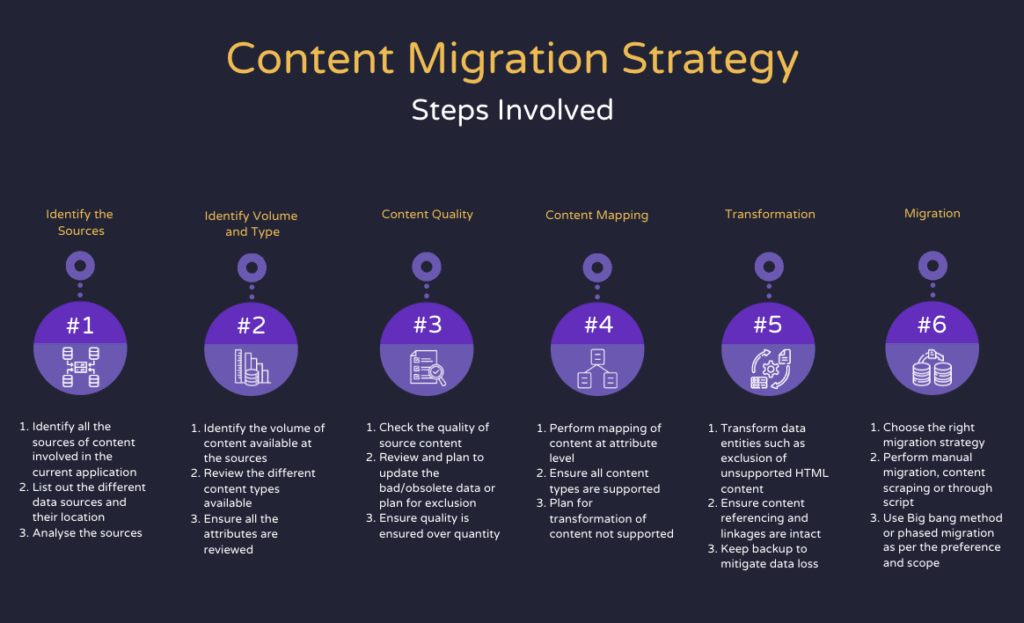
Identifying Your Content Sources
Content migration involves understanding where exactly your content is coming from. The myriad of sources can range from structured environments like your database to more dynamic platforms such as websites, mobile applications, and blogs.
Each of these content reservoirs harbors a unique set of content pieces, encapsulating everything from intricate product details and expansive asset inventories to sensitive files and documents.
The main steps involved in the identification of content sources are:
- Conducting a Comprehensive audit of the existing Platform
- Identifying the key content sources
Assessing Content Volume and Type
The pivotal step following the identification of your content sources is to closely evaluate both the volume and the specific nature of the data poised for migration. This stage is crucial for planning the logistical aspects of your migration project. For some entities, the challenge lies in handling vast quantities of bulk data that necessitate a robust, large-scale migration approach. Conversely, other scenarios may involve smaller, more manageable datasets that can be migrated with relative ease and agility.
Determining the volume would play a crucial role in formulating the specific migration technique to be used, as the volume would prove to be the vital element in determining the technique for content migration
This step involves finding the following details:
- Analysis of the Content Volume
- Classification of Content Types
- Evaluate complexity within content
- Review attribute level definitions and usage patterns
Ensuring Content Quality
Content quality is a critical factor that can make or break the success of a content migration strategy. Before embarking on the actual migration, an essential step is to scrutinize the existing datasets for any inaccuracies, obsolescence, or irrelevance that may compromise the integrity of the migration process. This task demands a rigorous audit of the data landscape to flag any elements that fall short of quality standards.
The process of ensuring data quality requires performing the following steps:
- A comprehensive review of the content by performing a Content audit
- Identify discrepancies such as duplicates, inconsistencies, and incomplete records
- Employ automated tools and manual checks to uncover content quality and compliance
- Ensure content relevance
Mapping Your Content
The essence of content mapping in a migration project lies in the intricate process of establishing accurate connections between the source content data fields and their corresponding destinations in the new system.
This step is not just about ensuring a match but about understanding the relationships and dependencies within the data. It demands a detailed analysis to guarantee that the migrated data not only lands in the right location but also retains its context and meaning, thus maintaining its utility and relevance in the new environment.
This process of performing mapping involves the following steps:
- Field Mapping: Map each field in the source system to the corresponding field in the target system. Include data type conversions and transformation rules if necessary.
- Content Transformation: Define any required transformations, such as format changes, aggregations, or standardizations.
- Relationship Mapping: Ensure that relationships between content data elements (e.g., foreign keys, links) are preserved and accurately mapped.
Transforming Your Content
Transforming content during a migration involves converting content from its original format in the source system to the required format in the target system. This process ensures that the content remains accurate, consistent, and usable in the new environment.
Transforming the content involves the following steps:
- Type Conversion: Define rules for converting data types (e.g., integer to string, date formats).
- Standardization: Establish standards for data formats (e.g., date formats, currency formats, naming conventions).
- Cleansing: Identify rules for cleansing, such as removing duplicates, correcting errors, and removing HTML, CSS, JS elements from content
- Enrichment: Define rules for enriching content, such as adding missing information, deriving new values, or combining fields.
- Maintain Content Integrity: Ensure the Integrity of the content is maintained after the transformation is complete
Choosing Your Migration Strategy
Selecting the optimal approach for migrating your data is a critical decision that hinges on several factors, including the scope of data, operational requirements, and risk tolerance.
Choosing the Migration Strategy would involve the following steps:
- Identifying the mode of migration: It would be essential to evaluate the right mode of migration to be used. Choosing the mode involves understanding if the content migration can be performed using Automated scripts, Manual migration, or Content Scraping. The decision lies in the volume, risks involved, and migration requirements.
- Identifying the technique for migration: Content Migration can be performed using the Big Bang method OR Phased Migration. The Big Band method offers a swift transition but with a heightened risk of disruption should issues arise. This approach might suit projects where downtime is minimal and the data landscape is relatively straightforward. A phased migration allows for a more measured and controlled transfer of data in incremental stages. This method affords the advantage of troubleshooting and fine-tuning the process as you progress, making it a preferred choice for complex environments.
Deciding between these strategies requires a careful evaluation of your specific situation, balancing the need for speed against the potential for complications. Ultimately, the choice should align with your overarching migration goals, ensuring a smooth and effective transition to the new system.
Conclusion
Apart from the strategic approach to content migration, it is essential to ensure that:
- Migration scope is clearly defined, and backup is taken before migration
- Continuous testing and reviews are ensured at each level of migration to identify risks
- Risk identification and mitigation planning are in place
- A fallback plan is defined
- Ensure system uptime when migrating – Plan during night hours, keep the scope of the fallback plan in case of corruption or failures
Deciding between these strategies requires a careful evaluation of your specific situation, balancing the need for speed against the potential for complications. Ultimately, the choice should align with your overarching migration goals, ensuring a smooth and effective transition to the new system.